



AI-Powered Food & Shopping Lists Launch for Beijing on Global OTAs
The initiative to promote Beijing’s inbound tourism through AI-generated multilingual video content was announced on May 31, 2026, at the Beijing Inbound Tourism Development Conference. Although the exact event date of public rollout was not specified, the collaboration with major overseas online travel agencies (OTAs) — including Booking, TripAdvisor, Expedia, and Klook — marks a regulatory-adjacent shift in how Chinese cultural and tourism offerings are positioned, certified, and algorithmically surfaced in international digital marketplaces.
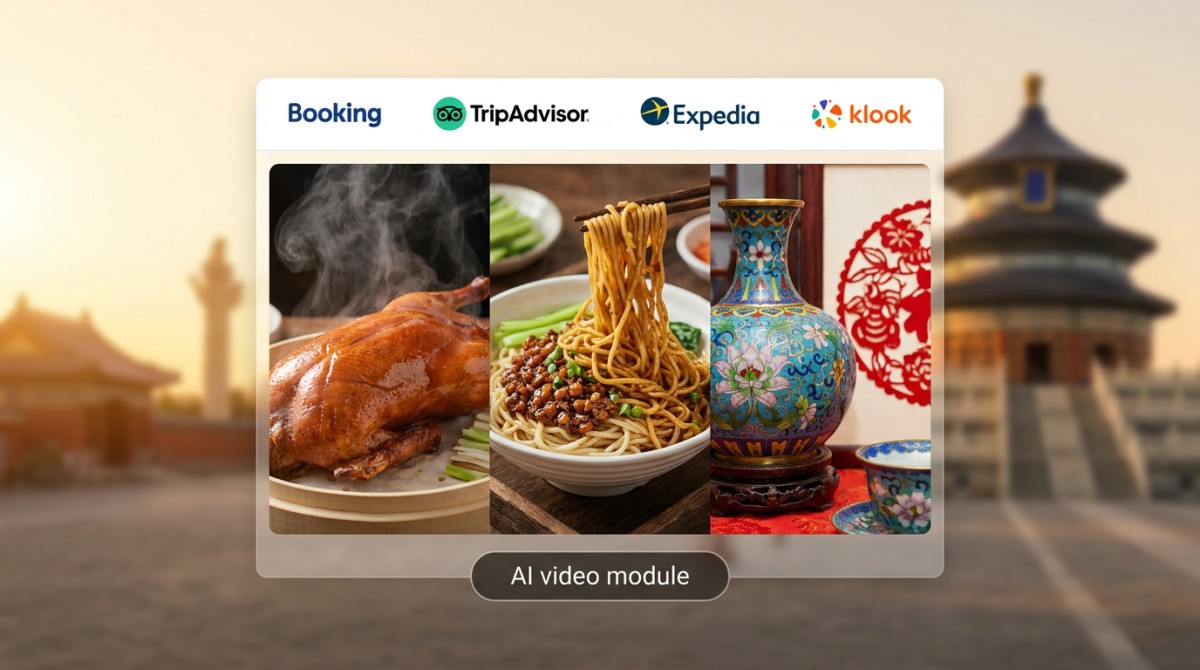
Launch of Multilingual 'Must-Eat' and 'Must-Buy' Lists via AI Video
On May 31, 2026, the Beijing Inbound Tourism Development Conference partnered with Booking, TripAdvisor, Expedia, and Klook to debut AI-generated short videos featuring Beijing’s ‘Must-Eat List’ and ‘Must-Buy List’. The lists were built using real consumer transaction data combined with AI-powered semantic analysis. They support instant retrieval in English, Japanese, Korean, French, and Spanish, and have been integrated directly into the search and recommendation engines of participating OTAs.
Impacts Across Tourism Supply Chain Roles
Direct Tourism Service Providers
These businesses — including restaurants, boutique retailers, and cultural experience operators — now face heightened visibility requirements. Since the AI-curated lists are algorithmically triggered by OTA search behavior, providers must ensure their offerings align with verified consumption patterns and multilingual metadata standards. Listing eligibility may increasingly depend on compliance with data transparency and digital tagging protocols defined by platform-level integration rules.
Destination Marketing & Content Agencies
Agencies responsible for promoting Beijing’s tourism assets must adapt to AI-driven content curation logic. Traditional campaign narratives are being supplemented — and in some cases superseded — by structured, data-validated, and linguistically localized video assets. This shifts emphasis from creative storytelling alone toward technical alignment with OTA recommendation APIs and multilingual semantic taxonomies.
Tourism Technology Integrators
Firms developing or managing PMS, CRM, or digital concierge systems for hotels and attractions need to assess compatibility with the new AI-video feed infrastructure. Integration may require updates to content ingestion pipelines, translation memory management, and real-time data synchronization with third-party OTA analytics layers.
Local Regulatory & Certification Support Services
Entities assisting businesses with tourism-related licensing, food safety certification, or cross-border e-commerce compliance must now account for multilingual digital exposure as part of risk assessment. For example, inclusion in a high-visibility ‘Must-Buy’ list may trigger enhanced scrutiny of labeling accuracy, product origin documentation, and service standard disclosures — particularly in non-English language interfaces.
Key Operational Considerations for Tourism Businesses
Alignment with OTA Recommendation Algorithms
Businesses should review how their digital profiles — including name spelling, category tags, operating hours, and review sentiment — map to the AI models powering the ‘Must-Eat’ and ‘Must-Buy’ rankings. Inconsistent or incomplete metadata may reduce algorithmic eligibility, regardless of actual service quality.
Multilingual Content Validation
Since AI-generated videos rely on semantic analysis across five languages, providers must verify that translated descriptions of dishes, products, or experiences retain accurate cultural and functional meaning — especially where idiomatic expressions or regional terminology apply. Misalignment could affect both user trust and platform-side classification accuracy.
Data Transparency & Source Verification Protocols
The use of real consumption data as a ranking input implies increasing expectations for verifiable, auditable transaction records. Tourism operators may soon be asked to demonstrate data provenance — for instance, proof of sales volume, customer nationality distribution, or review authenticity — to qualify for inclusion in future AI-curated lists.
Industry Observation: From Promotion to Algorithmic Compliance
Analysis shows this initiative reflects an emerging paradigm: inbound tourism promotion is evolving from standalone marketing campaigns into a regulated, platform-governed layer of digital trade infrastructure. What deserves closer attention is how OTA-level integration — once considered a commercial channel decision — is now functioning as a de facto compliance gateway. Observably, adherence to multilingual data structuring, semantic tagging, and real-time performance metrics is becoming a prerequisite for market access in key overseas digital environments. It is more appropriate to understand this as a soft regulatory convergence, where commercial platforms codify operational expectations that mirror formal certification criteria.
Strategic Significance for Cultural Tourism Ecosystems
This development signals a structural shift — not merely a promotional upgrade. By embedding AI-curated, multilingual lists directly into global OTA search ecosystems, Beijing establishes a scalable, self-updating mechanism for demand shaping and market qualification. The long-term implication is reduced reliance on manual outreach and increased dependence on interoperable digital readiness. Rational observation suggests that success will hinge less on scale or budget, and more on precision in data governance, linguistic fidelity, and platform-specific technical alignment.
Source Attribution & Ongoing Monitoring
This article was generated based solely on the provided title, event date (May 31, 2026), and summary description. Specific official source links were not provided in the input and should be verified continuously. Stakeholders are advised to monitor forthcoming guidance from the Beijing Municipal Bureau of Culture and Tourism, OTA platform policy updates (especially regarding AI-content integration requirements), and industry feedback on multilingual recommendation performance metrics.
您的1:1旅行顾问将在1个工作日内回复
如何计划行程
按月旅行指南
热门目的地
为什么选择我们

高性价比与透明体验
提供令人惊讶的低价,且不存在可选的旅游陷阱,既能让游客以低成本出行,又能避免不必要的消费套路,保障消费透明性。

个性化与专属服务
支持 100% 免费定制,搭配一对一专家服务,能根据游客的具体需求打造专属行程,同时提供专业指导,提升旅行的个性化和专业性。

优质行程规划
行程紧凑且内容丰富,能让游客在有限时间内体验更多内容;同时精选位置优越的酒店,为游客提供便利的住宿条件,整体提升旅行的舒适度和体验感。