



South China Port Freight Rates Drop 12%: Delivery Window for Cultural-Tourism Equipment Exports Extends to 45 Days
The exact event date was not specified; however, according to Drewry’s shipping consultancy data released on 25 May 2026, freight rates for 40-foot containers from major South China ports—Yantian (Shenzhen) and Nansha (Guangzhou)—to Europe and the U.S. East Coast fell 12% week-on-week, reaching the lowest level of 2026. Combined with the General Administration of Customs’ newly implemented ‘Green Channel for Cultural-Tourism Equipment Exports,’ total export delivery time has been reduced from an average of 62 days to under 45 days. This development directly impacts exporters of large-scale cultural-tourism equipment—including stage machinery and immersive theater systems—and reshapes delivery expectations for international buyers.
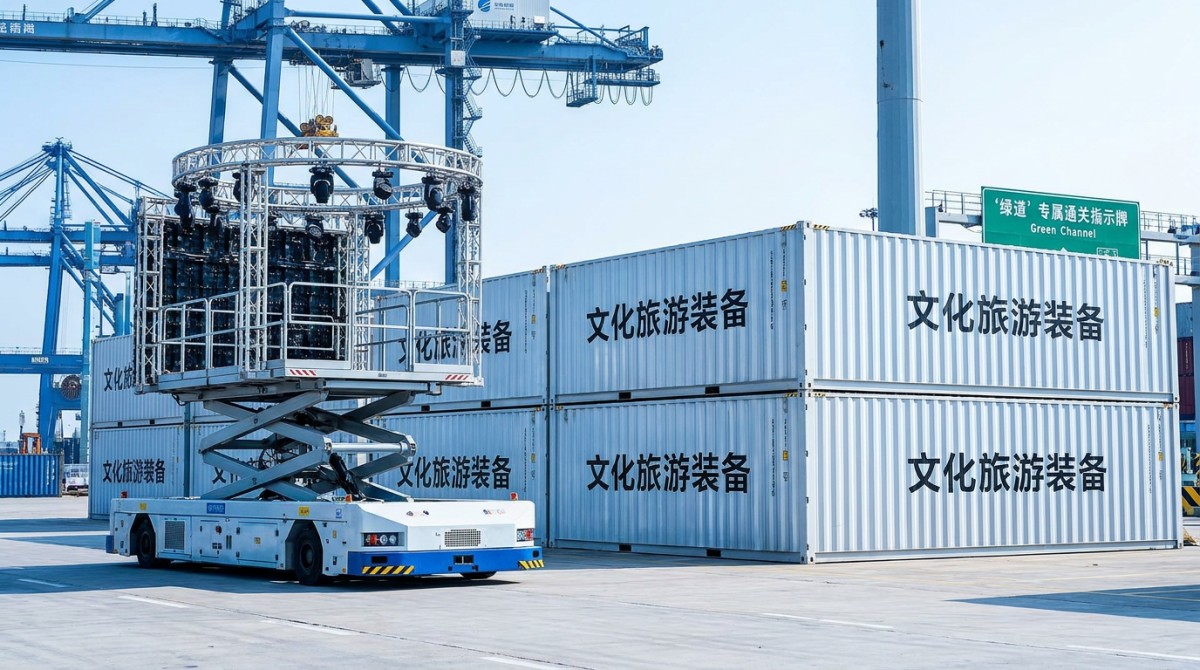
Confirmed Market Developments
Per Drewry’s 25 May 2026 report, 40-foot container freight rates from Yantian and Nansha ports to key transatlantic destinations declined by 12% compared to the prior week—marking the lowest point since the start of 2026. Concurrently, the General Administration of Customs launched a dedicated ‘Green Channel for Cultural-Tourism Equipment Exports,’ enabling accelerated customs clearance. As a result, the end-to-end export delivery cycle—from factory dispatch to overseas port arrival—has contracted from a historical average of 62 days to fewer than 45 days.
Impact Across Supply Chain Roles
Direct Exporters
Export-oriented manufacturers of large cultural-tourism equipment benefit most immediately: shorter lead times allow them to secure peak-season orders with greater confidence and offer fixed, predictable delivery schedules to overseas clients—enhancing competitiveness in tender-based projects.
Procurement-Focused Enterprises
Buyers and procurement agents now face tighter planning windows. With delivery timelines compressed, their internal approval cycles, contract finalization, and payment scheduling must align more precisely with the 45-day window—reducing buffer time for documentation or compliance adjustments.
Manufacturing Contractors
Contract manufacturers handling assembly, integration, or commissioning of stage systems or immersive installations must synchronize production planning, third-party testing, and technical documentation submission to meet the accelerated export schedule—especially where CE marking, EMC reports, or structural safety certifications are required pre-shipment.
Logistics & Compliance Service Providers
Freight forwarders and customs brokers specializing in cultural equipment exports need to adapt documentation workflows to the Green Channel’s procedural requirements—including pre-submission of equipment classification codes, conformity declarations, and supporting test reports—to avoid bottlenecks at clearance.
Strategic Priorities for Exporting Firms
Align Technical Documentation with Accelerated Timelines
With delivery windows shortened, firms must ensure all technical files—such as EU Declaration of Conformity, EN 62368-1 compliance reports, and mechanical safety assessments—are finalized and validated well before production completion, avoiding last-minute certification delays.
Optimize Component Sourcing and Assembly Sequencing
Long-lead imported components (e.g., servo drives, projection lenses, or certified control panels) require earlier procurement triggers. Manufacturers should revise bill-of-materials planning to accommodate the 45-day total cycle—not just port-to-port transit.
Verify Green Channel Eligibility Criteria Proactively
Eligibility for the customs Green Channel depends on accurate HS code classification, documented equipment function (e.g., ‘stage automation system’ vs. generic industrial machinery), and compliance with pre-clearance documentation standards. Firms should conduct internal eligibility audits ahead of shipment scheduling.
Update Customer Commitments and Contract Clauses
Sales teams must revise delivery terms in contracts and quotations to reflect the new 45-day benchmark—not the legacy 62-day norm—while incorporating contingency language for force majeure or regulatory verification delays.
Industry Perspective: Beyond Rate Cuts
Analysis shows this shift reflects more than temporary freight relief—it signals institutional prioritization of high-value cultural infrastructure exports. From an industry perspective, the Green Channel’s operationalization suggests growing alignment between trade facilitation policy and sector-specific technical complexity. What deserves closer attention is how customs authorities define and verify ‘cultural-tourism equipment’ in practice: inconsistent interpretation across ports could introduce new compliance friction despite the streamlined process. Observably, manufacturers investing in modular design, pre-certified subsystems, and digital product passports will gain disproportionate advantage in leveraging the shortened window.
Key Takeaway for Stakeholders
This adjustment does not eliminate logistical or regulatory complexity—but compresses its timeline. The 45-day window creates tangible leverage for exporters who proactively integrate compliance, documentation, and supply chain coordination into early-stage project planning. It also raises the bar for responsiveness: firms unable to synchronize technical, commercial, and customs processes risk ceding market share to more agile competitors—even with lower freight costs.
Source Attribution
This article synthesizes the provided title, event summary, and timestamp (25 May 2026). No specific official source links were provided in the input and should be verified continuously. Stakeholders are advised to monitor updates on Green Channel implementation guidelines from the General Administration of Customs, as well as evolving freight rate benchmarks from Drewry and other maritime analytics providers. Ongoing observation is warranted regarding regional port-level enforcement consistency, classification guidance for hybrid equipment (e.g., AI-integrated stage controllers), and buyer-side adoption of the new delivery expectations in tender specifications.
您的1:1旅行顾问将在1个工作日内回复
如何计划行程
按月旅行指南
热门目的地
为什么选择我们

高性价比与透明体验
提供令人惊讶的低价,且不存在可选的旅游陷阱,既能让游客以低成本出行,又能避免不必要的消费套路,保障消费透明性。

个性化与专属服务
支持 100% 免费定制,搭配一对一专家服务,能根据游客的具体需求打造专属行程,同时提供专业指导,提升旅行的个性化和专业性。

优质行程规划
行程紧凑且内容丰富,能让游客在有限时间内体验更多内容;同时精选位置优越的酒店,为游客提供便利的住宿条件,整体提升旅行的舒适度和体验感。